What is an offset mortgage, and who does it suit?
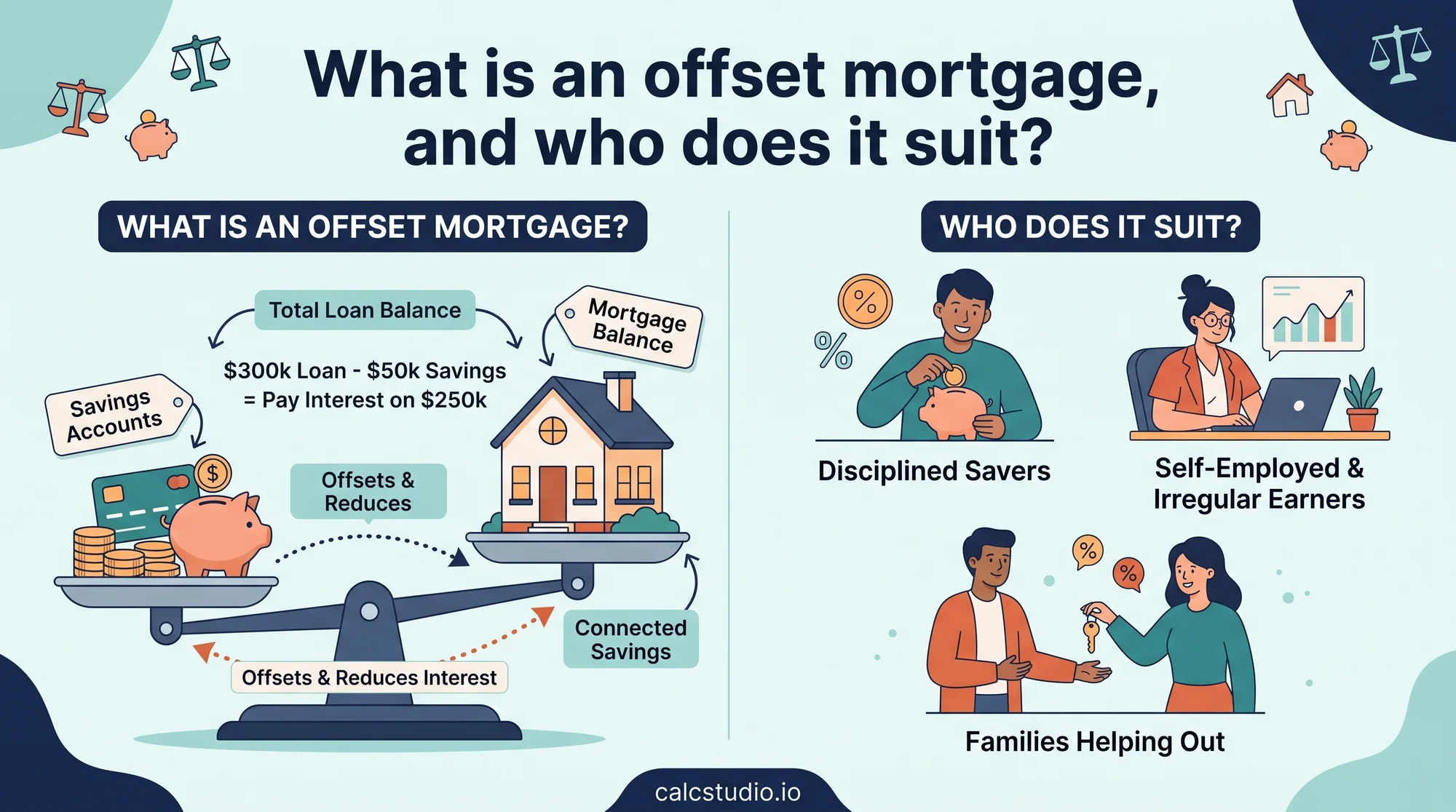
An offset mortgage uses money in eligible linked accounts to reduce the balance on which your loan charges interest. It can make accessible cash work against your mortgage without paying that cash into the loan.
That can suit people who maintain a meaningful savings buffer. Whether it saves money overall depends on the offset rate, fees, account rules and how much cash stays in those accounts. An offset is not automatically cheaper than a fixed loan.
Savings reduce interest, not the amount you owe
Suppose an eligible offset loan is $300,000 and linked accounts hold $50,000. Interest is charged on $250,000 while those balances apply. You still owe $300,000 before repayments; the linked savings remain separate.
Spend $10,000 from those accounts and the interest-bearing balance becomes $260,000, assuming nothing else changes. Withdrawals therefore reduce the benefit. Money earmarked for a tax bill or renovation only offsets the loan while it remains in the accounts.
Kiwibank, for example, calculates offset interest daily and specifies which accounts and family relationships qualify. Other lenders have their own rules. Ask what happens to interest earned on the linked accounts, and confirm which balances actually count.
If you keep the same loan payment and interest costs fall, more of that payment can reduce principal. Continue to make the required payments even when your savings cover the interest-bearing balance.
Compare the higher rate with the saving
Consider a hypothetical $300,000 loan with a fixed alternative at 5.5% and an offset alternative at 6.5%. Holding balances constant for a year, the fixed loan's interest is $16,500. With $50,000 offset savings, the offset loan charges 6.5% on $250,000, or $16,250.
The difference is only $250 before fees and any savings interest you give up. With $20,000 linked instead, the offset interest is $18,200, which is $1,700 more than the fixed comparison. The higher rate can outweigh a small offset balance.
Ignoring fees, repayments and foregone savings interest, the linked balance needed to match the fixed interest cost is about $46,154: $300,000 multiplied by one minus 5.5 divided by 6.5. This is a simplified break-even illustration, not a current rate quote or a complete product comparison.
For a fair financial comparison, also account for what savings could earn elsewhere after tax and fees. For an owner-occupied loan with non-deductible interest, avoiding interest does not create taxable investment income. Rental or business borrowing may need a different tax analysis.
Size the offset portion around reliable cash
You may be able to fix most of the mortgage and leave a smaller offset portion. If you reliably hold $40,000 in eligible accounts, a portion close to that amount might be largely offset, while the rest receives the chosen fixed rate.
Use a realistic balance after bills rather than the highest payday balance. If you expect to spend the cash soon, test the structure after that withdrawal. Allowing a large portion to float can be expensive when little cash remains against it.
Savings above the eligible loan balance cannot reduce its interest below zero. Ask how to manage surplus cash and whether it can earn interest elsewhere without disrupting the arrangement.
Who may find it useful
Households keeping an emergency fund accessible.
People with irregular income who hold cash between receipts and bills.
Borrowers saving for a planned expense and able to maintain that balance for a time.
Families using eligible linked accounts, where everyone understands access and withdrawal arrangements.
People with little spare cash may receive less benefit. A higher variable rate can also be uncomfortable if the loan portion is large. Compare the arrangement with fixed-rate extra-payment allowances and keeping a separate savings buffer.
Offset and revolving credit work differently
An offset keeps eligible cash in separate linked accounts. A revolving-credit facility works more like an overdraft: money paid in reduces borrowing, and spending can increase it again within the agreed limit.
Both can reduce interest through cash balances, but fees, limits, repayment requirements and access differ. Depositing cash into a linked offset account is also different from paying extra into the loan itself. Do not assume a principal repayment can be withdrawn later.
If relatives link accounts, confirm ownership, access and what happens when they remove money or end the arrangement. A family contribution should be voluntary and understood by everyone involved.
Read the calculator's assumptions
The calculator below compares a standard fixed loan with a separate offset loan at the rates you enter. Each has its own required monthly payment, so the offset payment may be higher. The offset scenario also assumes the monthly savings contribution you enter is available in addition to loan payments.
The model uses monthly periods and constant rates. Month one charges interest on the full loan; later months use the prior loan balance less the prior offset balance. It excludes withdrawals, fees, rate changes and interest earned on savings. A bank's daily calculation will differ.
Its payoff date is when the modelled loan balance reaches zero. A linked account fully covering a loan can stop interest, but it does not itself close the loan. Confirm discharge steps with your lender.
Try a lower savings balance, no monthly contribution and a higher offset rate as well as your preferred plan. These checks show whether the arrangement remains useful if your cash or rates change.
Questions for your lender
Which loan portion and accounts are eligible?
What variable rate and fees apply?
Do linked accounts earn interest?
Who can own linked accounts, and who controls withdrawals?
What payment is required when the loan is fully offset?
Can extra principal payments be redrawn?
For a potential lender switch, read the refinancing guide. Best Structure Finder can help explore a mixed structure; confirm all product terms with the lender.
Sources and further reading
Kiwibank: Offset home loans - a lender-specific example of account and access rules.
General information, not personalised financial advice. Examples use hypothetical rates and unchanged balances; actual savings depend on your loan and cashflow.
Compare your fixed and offset options
Use your lender's quoted rates and a savings balance you can realistically maintain. Check that both the loan payment and any monthly savings contribution fit your budget.
Live comparison
Fixed vs offset mortgage
See how an offset savings account can beat a lower fixed rate and pay the loan off early.
Whole-of-term comparison
The offset option could save you in interest
and clear the loan 15 months early - repaid in 8 years 9 months instead of 10 years.
Effective interest rate
Fixed mortgage
5.07%
4.99% advertised
Offset mortgage
3.52%
6.14% advertised
Interest on the offset loan is only charged on the balance minus your savings, so the 6.14% loan effectively costs just 3.52% a year.
Fixed mortgage
4.99% p.a.
- Monthly
- $7,421
- Total interest
- $190,540
- Total paid
- $890,540
- Paid off in
- 10 years
Offset mortgage
6.14% p.a.
- Monthly
- $7,821
- Total interest
- $114,299
- Total paid
- $814,299
- Paid off in
- 8 years 9 months
The offset mortgage carries a higher rate but links a savings account ($170,000 opening + $500/month) that reduces the interest-bearing balance, so more of each payment clears principal. Estimate only.
Loan balance over time
The offset mortgage reaches zero earlier despite the higher rate.
Fixed vs offset balance
Both start at the loan amount; the offset loan is paid off first.
Interest paid over time
How much interest each option costs across the first years and the whole term.
| Period | Fixed4.99% p.a. | Offset6.14% p.a. | You saveOffset vs fixed |
|---|---|---|---|
| 1 year | $33,675 | $31,535 | $2,140 |
| 2 years | $64,050 | $56,240 | $7,810 |
| 3 years | $91,671 | $77,496 | $14,175 |
| Whole term | $190,540 | $114,299 | $76,240 |
Offset schedule
Each month of the offset loan: your payment, where it goes, and your savings against what you owe.
| Month | Payment | Interest | Principal | Offset balance | Loan balance |
|---|---|---|---|---|---|
| 1 | $7,821 | $3,582 | $4,239 | $170,500 | $695,761 |
| 2 | $7,821 | $2,688 | $5,133 | $171,000 | $690,628 |
| 3 | $7,821 | $2,659 | $5,162 | $171,500 | $685,466 |
| 4 | $7,821 | $2,630 | $5,191 | $172,000 | $680,275 |
| 5 | $7,821 | $2,601 | $5,220 | $172,500 | $675,055 |
| 6 | $7,821 | $2,571 | $5,249 | $173,000 | $669,805 |
| 7 | $7,821 | $2,542 | $5,279 | $173,500 | $664,527 |
| 8 | $7,821 | $2,512 | $5,308 | $174,000 | $659,218 |
| 9 | $7,821 | $2,483 | $5,338 | $174,500 | $653,880 |
| 10 | $7,821 | $2,453 | $5,368 | $175,000 | $648,512 |
| 11 | $7,821 | $2,423 | $5,398 | $175,500 | $643,114 |
| 12 | $7,821 | $2,393 | $5,428 | $176,000 | $637,686 |
| 13 | $7,821 | $2,362 | $5,458 | $176,500 | $632,228 |
| 14 | $7,821 | $2,332 | $5,489 | $177,000 | $626,739 |
| 15 | $7,821 | $2,301 | $5,520 | $177,500 | $621,219 |
| 16 | $7,821 | $2,270 | $5,550 | $178,000 | $615,669 |
| 17 | $7,821 | $2,239 | $5,581 | $178,500 | $610,088 |
| 18 | $7,821 | $2,208 | $5,612 | $179,000 | $604,475 |
| 19 | $7,821 | $2,177 | $5,644 | $179,500 | $598,832 |
| 20 | $7,821 | $2,146 | $5,675 | $180,000 | $593,156 |
| 21 | $7,821 | $2,114 | $5,707 | $180,500 | $587,450 |
| 22 | $7,821 | $2,082 | $5,739 | $181,000 | $581,711 |
| 23 | $7,821 | $2,050 | $5,770 | $181,500 | $575,941 |
| 24 | $7,821 | $2,018 | $5,803 | $182,000 | $570,138 |
| 25 | $7,821 | $1,986 | $5,835 | $182,500 | $564,303 |
| 26 | $7,821 | $1,954 | $5,867 | $183,000 | $558,436 |
| 27 | $7,821 | $1,921 | $5,900 | $183,500 | $552,536 |
| 28 | $7,821 | $1,888 | $5,933 | $184,000 | $546,604 |
| 29 | $7,821 | $1,855 | $5,965 | $184,500 | $540,639 |
| 30 | $7,821 | $1,822 | $5,999 | $185,000 | $534,640 |
| 31 | $7,821 | $1,789 | $6,032 | $185,500 | $528,608 |
| 32 | $7,821 | $1,756 | $6,065 | $186,000 | $522,543 |
| 33 | $7,821 | $1,722 | $6,099 | $186,500 | $516,444 |
| 34 | $7,821 | $1,688 | $6,133 | $187,000 | $510,312 |
| 35 | $7,821 | $1,654 | $6,166 | $187,500 | $504,145 |
| 36 | $7,821 | $1,620 | $6,201 | $188,000 | $497,945 |
| 37 | $7,821 | $1,586 | $6,235 | $188,500 | $491,710 |
| 38 | $7,821 | $1,551 | $6,269 | $189,000 | $485,441 |
| 39 | $7,821 | $1,517 | $6,304 | $189,500 | $479,137 |
| 40 | $7,821 | $1,482 | $6,339 | $190,000 | $472,798 |
| 41 | $7,821 | $1,447 | $6,374 | $190,500 | $466,424 |
| 42 | $7,821 | $1,412 | $6,409 | $191,000 | $460,015 |
| 43 | $7,821 | $1,376 | $6,444 | $191,500 | $453,571 |
| 44 | $7,821 | $1,341 | $6,480 | $192,000 | $447,091 |
| 45 | $7,821 | $1,305 | $6,516 | $192,500 | $440,576 |
| 46 | $7,821 | $1,269 | $6,551 | $193,000 | $434,024 |
| 47 | $7,821 | $1,233 | $6,588 | $193,500 | $427,437 |
| 48 | $7,821 | $1,197 | $6,624 | $194,000 | $420,813 |
| 49 | $7,821 | $1,161 | $6,660 | $194,500 | $414,153 |
| 50 | $7,821 | $1,124 | $6,697 | $195,000 | $407,456 |
| 51 | $7,821 | $1,087 | $6,734 | $195,500 | $400,722 |
| 52 | $7,821 | $1,050 | $6,771 | $196,000 | $393,952 |
| 53 | $7,821 | $1,013 | $6,808 | $196,500 | $387,144 |
| 54 | $7,821 | $975 | $6,845 | $197,000 | $380,298 |
| 55 | $7,821 | $938 | $6,883 | $197,500 | $373,415 |
| 56 | $7,821 | $900 | $6,921 | $198,000 | $366,495 |
| 57 | $7,821 | $862 | $6,959 | $198,500 | $359,536 |
| 58 | $7,821 | $824 | $6,997 | $199,000 | $352,539 |
| 59 | $7,821 | $786 | $7,035 | $199,500 | $345,504 |
| 60 | $7,821 | $747 | $7,074 | $200,000 | $338,431 |
| 61 | $7,821 | $708 | $7,112 | $200,500 | $331,318 |
| 62 | $7,821 | $669 | $7,151 | $201,000 | $324,167 |
| 63 | $7,821 | $630 | $7,191 | $201,500 | $316,976 |
| 64 | $7,821 | $591 | $7,230 | $202,000 | $309,746 |
| 65 | $7,821 | $551 | $7,269 | $202,500 | $302,477 |
| 66 | $7,821 | $512 | $7,309 | $203,000 | $295,168 |
| 67 | $7,821 | $472 | $7,349 | $203,500 | $287,819 |
| 68 | $7,821 | $431 | $7,389 | $204,000 | $280,429 |
| 69 | $7,821 | $391 | $7,430 | $204,500 | $273,000 |
| 70 | $7,821 | $350 | $7,470 | $205,000 | $265,529 |
| 71 | $7,821 | $310 | $7,511 | $205,500 | $258,018 |
| 72 | $7,821 | $269 | $7,552 | $206,000 | $250,466 |
| 73 | $7,821 | $228 | $7,593 | $206,500 | $242,873 |
| 74 | $7,821 | $186 | $7,635 | $207,000 | $235,239 |
| 75 | $7,821 | $144 | $7,676 | $207,500 | $227,562 |
| 76 | $7,821 | $103 | $7,718 | $208,000 | $219,844 |
| 77 | $7,821 | $61 | $7,760 | $208,500 | $212,084 |
| 78 | $7,821 | $18 | $7,802 | $208,500 | $204,282 |
| 79 | $7,821 | $0 | $7,821 | $208,500 | $196,461 |
| 80 | $7,821 | $0 | $7,821 | $208,500 | $188,640 |
| 81 | $7,821 | $0 | $7,821 | $208,500 | $180,819 |
| 82 | $7,821 | $0 | $7,821 | $208,500 | $172,999 |
| 83 | $7,821 | $0 | $7,821 | $208,500 | $165,178 |
| 84 | $7,821 | $0 | $7,821 | $208,500 | $157,357 |
| 85 | $7,821 | $0 | $7,821 | $208,500 | $149,536 |
| 86 | $7,821 | $0 | $7,821 | $208,500 | $141,716 |
| 87 | $7,821 | $0 | $7,821 | $208,500 | $133,895 |
| 88 | $7,821 | $0 | $7,821 | $208,500 | $126,074 |
| 89 | $7,821 | $0 | $7,821 | $208,500 | $118,253 |
| 90 | $7,821 | $0 | $7,821 | $208,500 | $110,433 |
| 91 | $7,821 | $0 | $7,821 | $208,500 | $102,612 |
| 92 | $7,821 | $0 | $7,821 | $208,500 | $94,791 |
| 93 | $7,821 | $0 | $7,821 | $208,500 | $86,971 |
| 94 | $7,821 | $0 | $7,821 | $208,500 | $79,150 |
| 95 | $7,821 | $0 | $7,821 | $208,500 | $71,329 |
| 96 | $7,821 | $0 | $7,821 | $208,500 | $63,508 |
| 97 | $7,821 | $0 | $7,821 | $208,500 | $55,688 |
| 98 | $7,821 | $0 | $7,821 | $208,500 | $47,867 |
| 99 | $7,821 | $0 | $7,821 | $208,500 | $40,046 |
| 100 | $7,821 | $0 | $7,821 | $208,500 | $32,225 |
| 101 | $7,821 | $0 | $7,821 | $208,500 | $24,405 |
| 102 | $7,821 | $0 | $7,821 | $208,500 | $16,584 |
| 103 | $7,821 | $0 | $7,821 | $208,500 | $8,763 |
| 104 | $7,821 | $0 | $7,821 | $208,500 | $942 |
| 105 | $942 | $0 | $942 | $208,500 | Paid off |
Loan balance over time
The offset mortgage reaches zero earlier despite the higher rate.
Fixed vs offset balance
Both start at the loan amount; the offset loan is paid off first.