Should I refinance? Cashback, break fees and offset explained
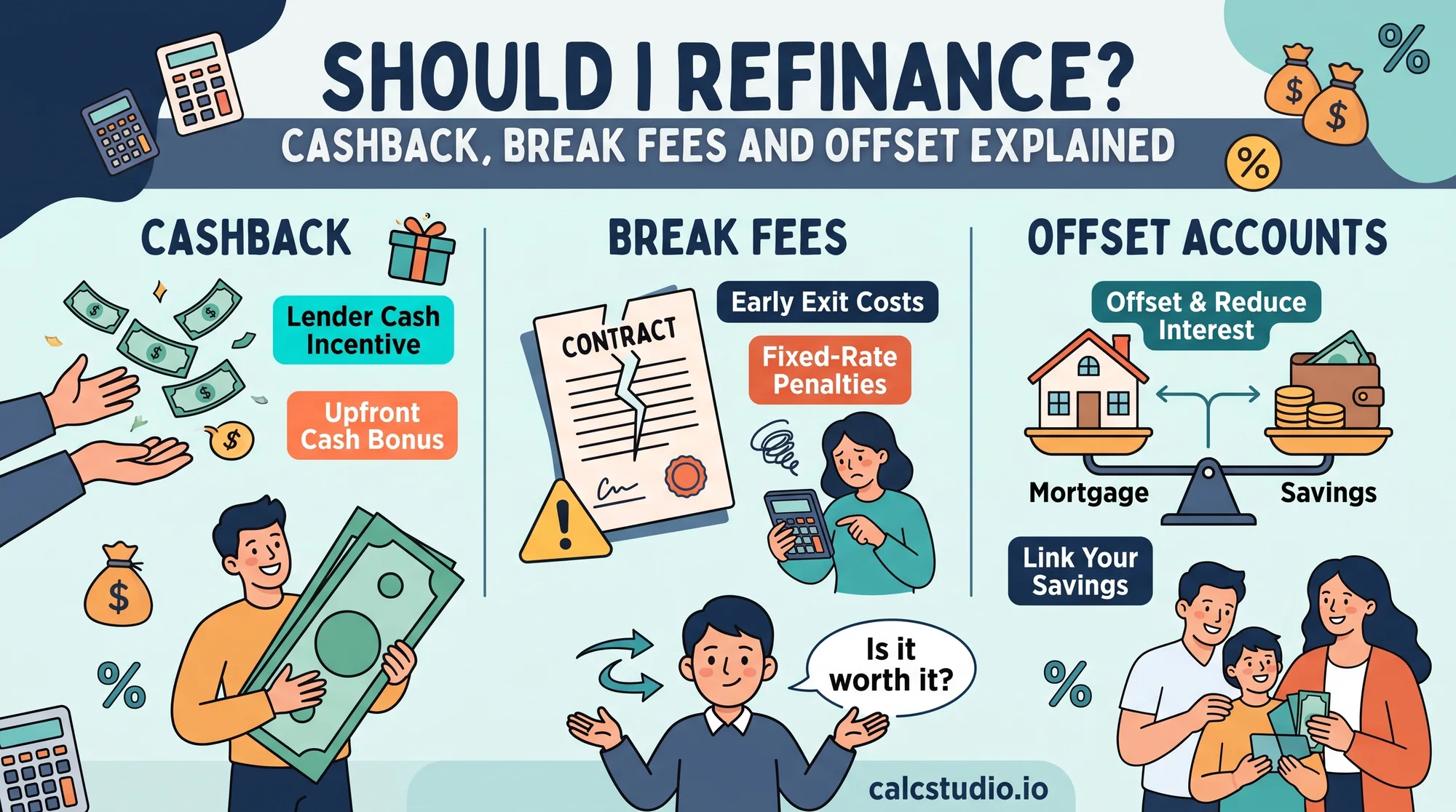
Refinancing moves your mortgage to another lender. A lower rate or a useful loan structure can improve your finances, but the benefit needs to outweigh switching costs and any conditions attached to the offer.
Start by asking your current lender what it can offer. Refixing with that lender may achieve some of the benefit without a full move. Then compare written offers using the same balance, remaining term and repayment plan.
Compare the cost over the time you expect to stay
A lifetime interest estimate can help illustrate a strategy, but it does not tell you whether moving now pays for itself. Future rates are unknown, and you may sell or refinance again before the mortgage ends.
As a simple illustration, a one-percentage-point rate reduction on an unchanged $500,000 balance saves about $5,000 of interest in one year. If switching costs net of usable cashback are $3,000, that suggests roughly 7.2 months to recover those costs. Actual principal-and-interest balances fall, rates can change, and the timing of charges matters, so this is an initial screen rather than a precise forecast.
List break costs, legal work, discharge fees, valuation costs and any cashback repayment owed to your current lender. Ask whether the new lender's contribution genuinely covers them. Compare the net saving over your likely holding period.
Read cashback conditions carefully
A cash contribution is an incentive with conditions, not a guaranteed return. The lender may require repayment of some or all of it if you leave within an agreed period. Ask for the amount, payment date, retention period and repayment formula in writing.
Consider what happens if you sell, reduce the loan substantially or change lenders again. An attractive cashback may be less valuable when your plans make a repayment likely.
The calculator below assumes cashback of 1% of the loan balance less $1,500 legal costs, floored at zero. It does not cap that estimate and does not let you enter your actual cashback offer. Compare the assumed amount with the written offer separately; do not treat it as money a bank has promised.
Get a current break-cost quote
Ending a fixed rate early can trigger an early repayment charge. Its calculation depends on your contract and the lender's funding-cost method, not simply the difference between two advertised mortgage rates.
Ask your lender for a dated quote and when it expires. Other fees can still apply even when a fixed-rate break charge is zero. Waiting until the fixed period ends may avoid that charge, but rates available then are unknown.
The calculator excludes break costs and does not delay a switch until your fixed period expires. It models the new rate from the start of the scenario. The fixed-term selection helps choose a comparison rate; it is not a countdown that waits to refinance.
Avoid resetting the mortgage clock accidentally
A lower repayment can come from a lower rate, a longer term, or both. Extending a mortgage with 20 years remaining back to 30 years spreads payments out and may increase total interest, even at a lower rate.
Compare offers over your existing remaining term first. If you need a longer term for affordability, ask how it changes total cost. If a lower rate frees up cash, consider whether maintaining your payment is sustainable and permitted under the new agreement.
Understand the offset scenario
Eligible linked account balances can reduce the amount on which an offset loan charges interest. The money remains in the linked accounts; it is not automatically a repayment of the loan principal. The actual benefit depends on daily balances, the offset rate, fees and the portion of debt eligible for offsetting.
In the calculator's combined scenario, the assumed cashback and everyday account balance seed the offset account. The difference between your current payment and the new minimum, plus the extra monthly amount you enter, builds that account. The scenario assumes those funds remain available to offset the debt.
This is more than a lower-rate comparison. Its savings include changes in cashflow and the use of savings. The model applies the entered new rate to the offset scenario; a real lender may price its offset portion differently. Use Offset Saver to compare separate fixed and offset rates, and confirm the proposed structure with the lender.
What the three results mean
Your loan today uses your current rate and payment, subject to the required minimum.
Your new loan uses the new rate and its minimum payment over the remaining term.
Your optimal solution combines the new rate, retained cashflow, extra contributions and assumed cashback with an offset account.
The model holds each scenario's rate constant into the future. Its savings are measured against your loan contract: your current rate, the required repayment and the remaining term. For the combined scenario, the finish line is when offset savings cover the debt; that is different from the lender having received full repayment and discharged the mortgage.
Before deciding to switch
Obtain a written offer and confirm rate eligibility.
Get dated switching-cost and cashback repayment quotes.
Compare the same balance and remaining term.
Check the extra-payment and linked-account rules.
Test whether savings still outweigh costs over your likely stay.
Confirm the new lender's approval before committing to the move.
Today's Best Rates is a starting point for published fixed rates. Your actual offer can differ. A lender or mortgage adviser can help assess the complete package and your circumstances.
Sources and further reading
ANZ: Home loan terms and conditions - one lender's example; your agreement governs your charges.
General information, not personalised financial advice. Examples are hypothetical; calculator results depend on the stated assumptions.
Compare your refinancing scenarios
Enter your existing balance, rate, payment and remaining term. Check the offered new rate, then compare the result with your actual costs and product conditions outside the calculator.
Rate check
Would refinancing save you money?
Your mortgage today against a switch to today's rate for your fixed term, with an offset account working for you.
Your optimal solution
You could save up to
and pay your mortgage off 9 yr 7 mo sooner than your loan contract.
Of that, about $4,985 and 1 month comes from the extra you already pay, and about $388,410 and 9 yr 6 mo from the new rate.
Cashback and offset
- Cashback (1% less $1,500 legal costs)
- $5,000
- Offset opening balance
- $20,000
- Monthly top-up to the offset
- $1,104
- What you actually pay each month
- $4,900
Savings are measured against your loan contract: your current rate, the required repayment and the remaining term. Cashback assumes 1% of your balance less $1,500 legal costs; lender offers vary. Estimate only.
Loan balance over time
Your optimal solution shows what you owe less your offset account, so it reaches $0 the month the offset covers the loan.
Your loan contract vs your new loan vs your optimal solution
Each loan ends when it is paid off.
Comparison table
| Measure | Your loan contractCurrent rate 6.5%, required repayment | Your new loanNew rate 4.99%, required repayment | Your optimal solutionRecommendedNew rate 4.99% + keep your current repayment + pay extra |
|---|---|---|---|
| Minimum monthly repayment | $4,389 | $3,796 | $3,796 |
| Your actual repayment | — | — | $4,400 |
| Payoff time | 25 years | 25 years | 15 yr 5 mo |
| Total interest amount | $666,654 | $488,815 | $273,259 |
| Interest saved (from your loan contract) | — | $177,839 | $393,395 |
| Time saved | — | — | 9 yr 7 mo |
Interest saved over time
"Your loan contract" vs "Your optimal solution" - cumulative interest saved at each point.
1 year
$11,132
2 years
$22,974
3 years
$35,552
Whole term
$393,395
Loan balance over time
Your optimal solution shows what you owe less your offset account, so it reaches $0 the month the offset covers the loan.
Your loan contract vs your new loan vs your optimal solution
Each loan ends when it is paid off.