How much can I borrow in New Zealand?
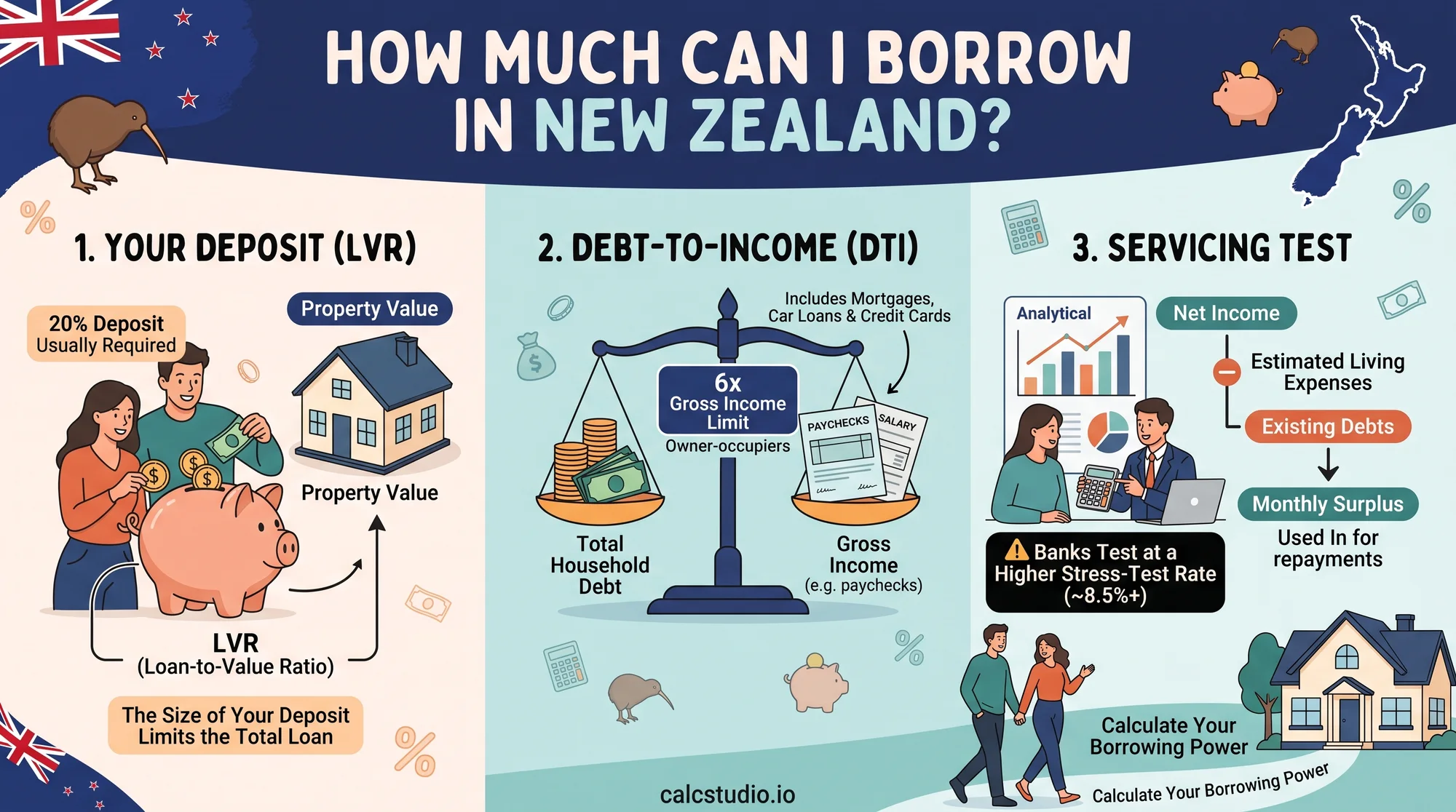
Your income is only one part of a mortgage application. A lender also checks your spending, existing debts, deposit and the property you want to buy. The amount it will lend can be lower than a calculator estimate, and the amount you are comfortable repaying can be lower again.
A useful starting point is to compare three constraints: repayment affordability, debt relative to income, and the deposit required. Understanding which one matters most helps you choose your next step.
Start with what your household can repay
Work out your reliable take-home income, then deduct living costs and debt payments. Include annual bills as monthly amounts: insurance, vehicle costs and school expenses can disappear from a budget if you only look at one month's transactions. Allow for home ownership costs such as rates, maintenance and insurance.
Banks assess income and expenses under their own policies. Overtime, bonuses, self-employed income and boarder income may need evidence or receive different treatment. A calculator cannot decide whether a lender will accept them.
Lenders generally test affordability at an assessment rate above the offered mortgage rate. This checks whether repayments remain manageable if rates rise. The calculator below opens on the banks' average test rate supplied by Rates Hub; check its as-at date and enter your lender's figure if you know it.
For illustration, a $500,000 loan over 30 years costs about $3,327 a month at 7%, using monthly principal-and-interest payments and an annual rate divided by 12. That is a hypothetical repayment example, not a lender offer or an approval.
Understand debt-to-income rules
Debt-to-income, or DTI, compares total debt with annual gross income. The Reserve Bank's rules allow banks to make up to 20% of new owner-occupier lending above a DTI of 6, and up to 20% of investor lending above 7. These are bank lending speed limits, not an absolute borrowing entitlement or a universal personal cap.
For a household earning $100,000 before tax, six times income is $600,000 of total debt. If $40,000 of other debt counts in the assessment, a $560,000 mortgage brings total debt to that threshold. The lender can still approve less after checking affordability.
Exemptions apply, including Kāinga Ora First Home Loans and certain refinancing and construction lending. Confirm the treatment of your application with the lender.
The calculator uses a simplified six-times-gross-income cap on the proposed mortgage. It accounts for other debt repayments in affordability, but does not subtract all existing debt balances from that cap or model every DTI exemption. Treat its result as an estimate, especially if you have substantial existing debt.
Work out what your deposit supports
At a 20% deposit, $100,000 supports a $500,000 purchase and a $400,000 loan, before purchase costs. A larger deposit can also improve access to rates and reduce low-equity charges, depending on the lender.
The Reserve Bank currently allows up to 25% of new owner-occupier lending above 80% LVR, and up to 10% of investor lending above 70% LVR. A smaller deposit can therefore be possible, but approval depends on the lender's capacity and criteria. A 20% deposit is not a legal minimum for every buyer.
The calculator uses 20% for its standard deposit scenario, or 5% when First Home Loan is selected. That switch changes the estimate; it does not assess scheme eligibility. Check the first-home buyer guide and speak with a participating lender before relying on it.
Read the lowest constraint first
Suppose an affordability assessment supports $500,000, the income comparison supports $600,000, and your deposit supports $400,000 at 20%. The deposit is the constraint in that scenario. Increasing income alone would not change it.
If affordability is the constraint, review sustainable spending and existing repayments. If deposit is the constraint, consider a lower purchase price, more savings or a low-deposit option you qualify for. If total debt relative to income is high, ask the lender how existing balances and credit limits affect the application.
Do not drain your emergency money just to increase the deposit. Keep a separate allowance for legal work, reports, moving costs and unexpected repairs.
Prepare before applying
Gather payslips or the income records your lender requests.
Review bank statements and make an honest household budget.
List debts, credit limits and repayments, including buy-now-pay-later commitments.
Confirm your usable savings, eligible KiwiSaver withdrawal and any gift conditions.
Ask which assessment rate, loan term and deposit requirement will apply.
Check what a conditional approval requires before making an offer.
A borrowing range is a planning tool. It does not confirm finance for a particular home. Use Repayment Check to test a proposed loan against your own budget, and Income Target for a simple take-home cashflow estimate.
Sources and further reading
Rules checked on 14 October 2026. General information, not personalised financial advice or a lending approval.
Try your own borrowing estimate
Enter your income basis carefully, replace suggested living costs with your actual costs, and select First Home Loan only if eligibility has been confirmed. Read the assumptions alongside the result.
Borrowing estimate
How much could I borrow for my first home?
Your income, costs and deposit against the three limits a lender applies.
Your estimate
You could borrow
Purchase budget $500,000 – $550,000 with your $110,000 deposit.
Repayment at your limit
$2,892 a month
Debt-to-income 2.6× (the Reserve Bank limit is 6×). Estimate only.
What limits you
Three things cap the loan. The lowest one is your answer.
Repayments
$1,107,205
What your monthly surplus can repay
6× income
$1,020,000
The Reserve Bank's limit: 6 times household income before tax, less what you already owe
DepositYour limit
$440,000
What your savings are the minimum deposit on
- Your deposit sets your limit: $110,000 is 20% of a $550,000 home. More savings raise it.
- Your target of $850,000 is $300,000 above your purchase budget.
- Each $100 a month of debt lowers your repayments limit by about $15,215.