First home buyers: deposit, KiwiSaver and the First Home Loan
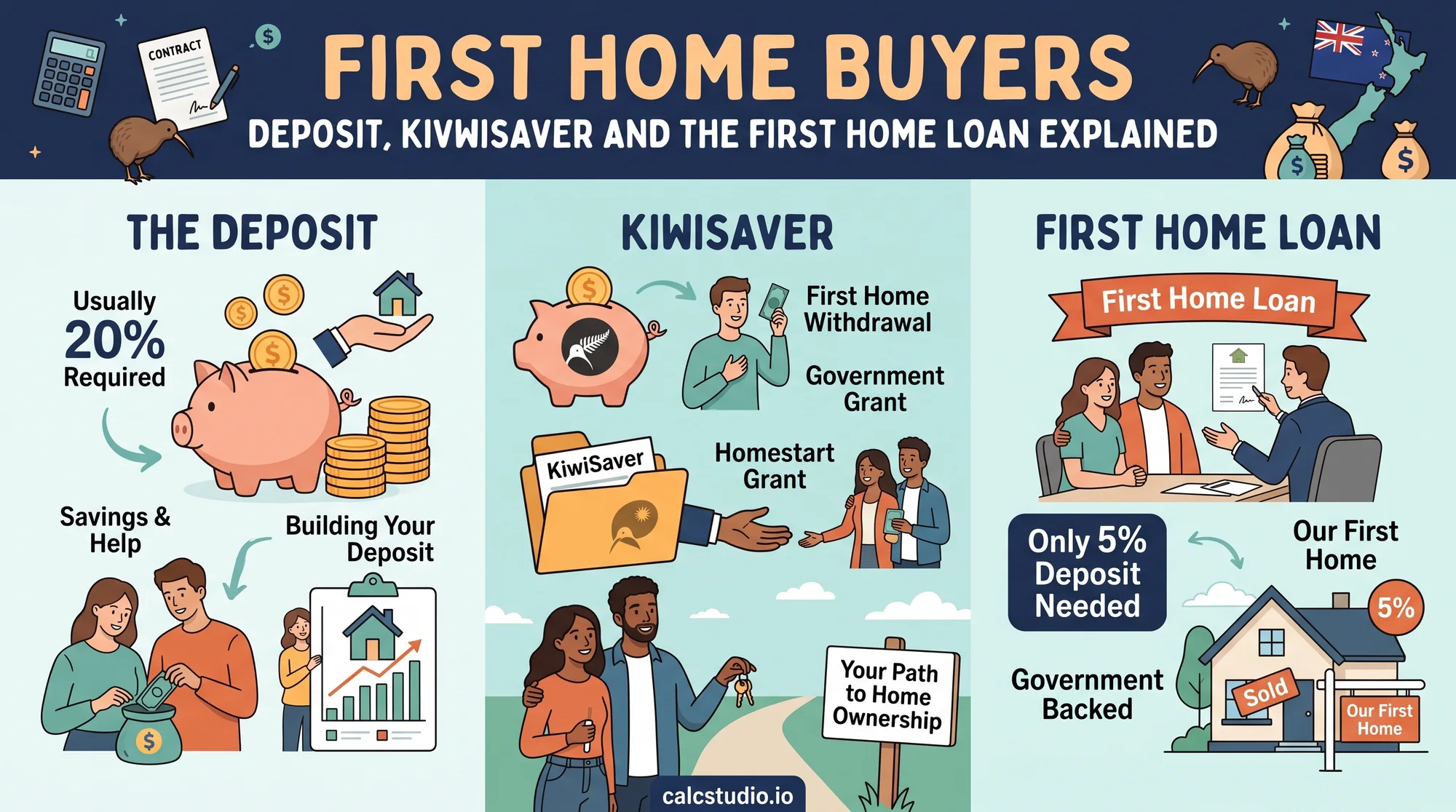
A first-home deposit can combine savings, an eligible KiwiSaver withdrawal and other funds a lender accepts. The challenge is working out how much is available, when it can be used, and whether the remaining mortgage fits your budget.
Keep three questions separate: how much deposit you have, whether you qualify for a low-deposit loan, and whether you can afford repayments. A positive answer to one does not settle the other two.
What a 5%, 10% or 20% deposit means
On a hypothetical $700,000 home, a 20% deposit is $140,000 and the mortgage is $560,000. At 10%, the deposit is $70,000 and the mortgage is $630,000. At 5%, it is $35,000 and $665,000. These figures exclude fees and other purchase costs.
A smaller deposit means borrowing more for the same property. It may also affect the rate or low-equity charges. Ask the lender for the full offer rather than comparing the advertised rate alone.
The Reserve Bank's LVR rules limit banks' high-LVR lending: up to 25% of new owner-occupier lending may be above 80% LVR. This makes some low-deposit lending possible; it does not guarantee a 10% or 5% loan. Lenders apply their own criteria, and some lending is exempt.
Check your usable KiwiSaver balance
IRD says you must have been in KiwiSaver for at least three years to make a first-home withdrawal. You must leave $1,000 in the account, and funds transferred from an Australian complying superannuation scheme cannot be withdrawn for this purpose.
Ask your provider for your eligible withdrawal amount. Your account balance alone is not proof of what can be used. The home must meet the withdrawal criteria, and eligible previous homeowners may need a Kāinga Ora determination.
Talk to your provider and lawyer early about processing time, documents and the purchase agreement. Do not assume a withdrawal can arrive by an auction deposit deadline or reimburse money you have already paid. Confirm how it can be used before signing an unconditional agreement.
For planning, suppose a provider confirms $40,000 is withdrawable and you have $35,000 in cash. That gives $75,000 before setting aside purchase costs. If you reserve $10,000 for costs and a buffer, $65,000 remains towards the price. The reserve is illustrative; obtain actual quotes for your purchase.
What the First Home Loan does
First Home Loans are offered by participating lenders and underwritten by Kāinga Ora. They can reduce the required deposit to 5%, subject to eligibility and the lender's approval. They are loans to repay, rather than a grant towards the purchase.
Kāinga Ora's published brochure lists income limits based on before-tax income over the previous 12 months: $95,000 for an individual buyer without dependants, $150,000 for an individual buyer with dependants, and $150,000 combined for multiple buyers. It also lists residency, home ownership and owner-occupation requirements. Confirm current criteria with the participating lender, including any special household circumstances.
The brochure lists a 1.2% lender's mortgage insurance premium, payable upfront or added to the loan. Ask for the current charge and any application fee. Financing a fee increases the debt and the interest paid on it.
A 5% deposit does not guarantee that your income can support the other 95%. The lender still checks affordability and the property. Do not select the calculator's First Home Loan option merely because you want a smaller deposit.
The First Home Grant is different
The First Home Grant closed to new applications on 22 May 2024. It should not be included as new funding in your deposit plan. A KiwiSaver withdrawal and a First Home Loan are separate arrangements with their own conditions.
Your funding may also include a gift or other accepted assistance. Tell the lender whether money is a gift or repayable loan, and ask what evidence is needed. Borrowed deposit money can create additional commitments.
Build a budget for owning the home
Include legal costs, due-diligence reports, any valuation, moving expenses and insurance arrangements. After settlement, allow for council rates, maintenance, insurance and body corporate costs where relevant. A mortgage payment is only part of the monthly cost.
Use the income calculator below as a cashflow illustration. It adds the mortgage repayment, the expenses you enter and a fixed $100 monthly buffer. That buffer is the calculator's assumption, not a universal bank requirement. Your lender may use higher expenses and a higher assessment rate.
For example, a $560,000 loan at a hypothetical 6% over 30 years has a monthly payment of about $3,357. Add your actual costs to assess affordability, then test a higher rate. A simple budget result does not establish how much gross income a bank will accept or approve.
Before you make an offer
Confirm the cash and KiwiSaver funds available at each payment deadline.
Ask whether you meet First Home Loan criteria, if relevant.
Obtain finance approval and understand its conditions and expiry.
Have your lawyer review the agreement and any conditions.
Confirm the lender accepts the property and required insurance.
Keep a practical cash reserve after settlement.
Use How Much Can I Borrow? for a broader estimate, remembering that it simplifies lender rules and does not establish scheme eligibility.
Sources and further reading
Sources checked on 14 October 2026. General information, not personalised financial or legal advice. Confirm eligibility and current charges before applying.
Estimate the take-home income your budget needs
Enter your price, deposit, rate and actual expenses below. Use the result to start a lender conversation, and read the assumptions before relying on it.
Live estimate
Work out the income a loan needs
Enter the home, the loan and your outgoings to see the take-home income a lender would want to see.
Your estimate
Take-home income needed each month
Each year
Loan repayment
On a $1,080,000 loan
Lender buffer
Left over each month
Take-home (after-tax) income. Lenders look for at least $100 a month left over after all debts and expenses. Estimates only - lenders apply their own test rates and expense figures.